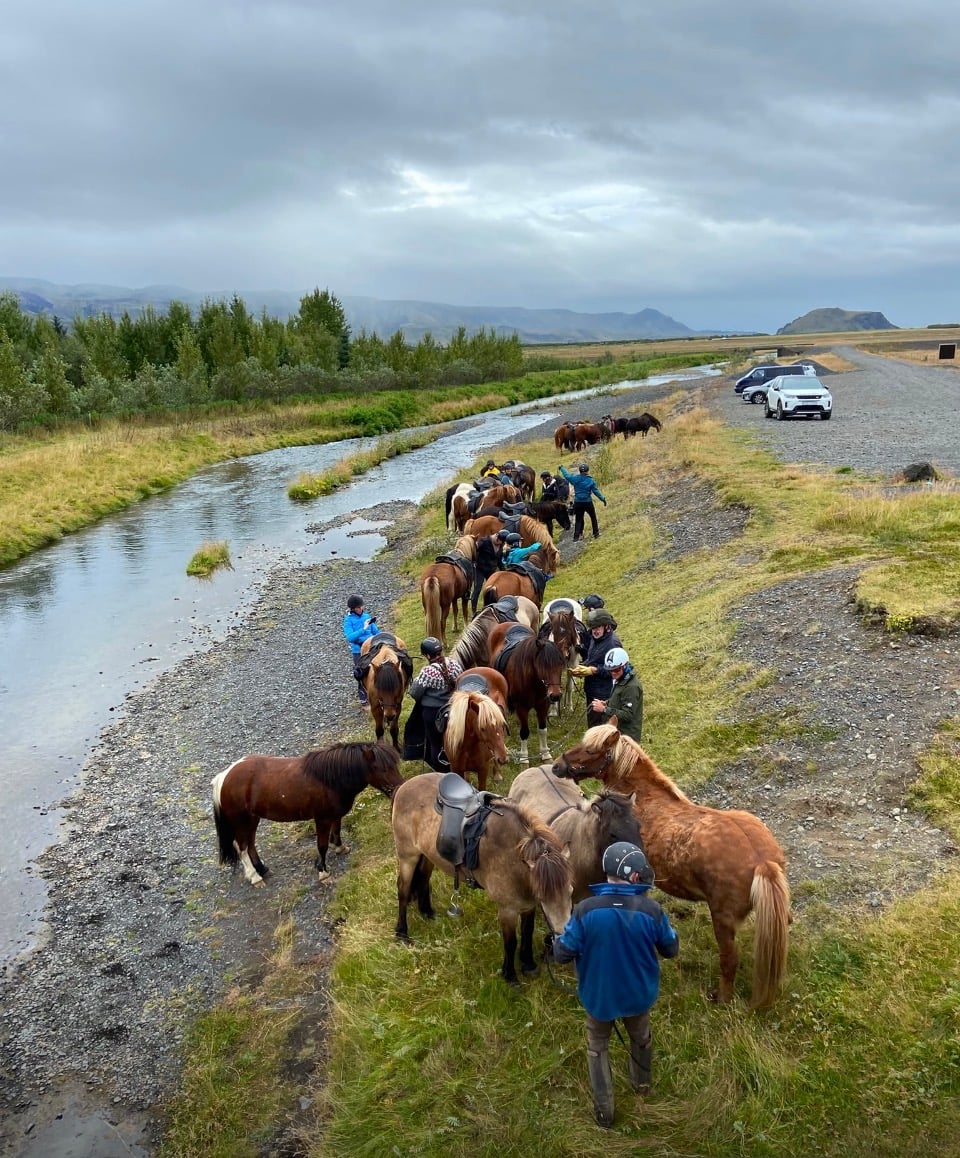
I went to Iceland to learn something about myself through my first solo international trip. What I signed up for was a four-day horseback riding tour with people I had never met, riding for the first time after thirty years of dust settling on my gear. Not just riding, but riding for four days straight with a loose herd of horses running alongside us. What I did not expect was to come home having learned about leadership instead.
Our guide was a woman who was efficient, patient, and kind, though those words only describe the surface of what she did. What actually mattered was her uncanny ability to see the smallest mistake. A saddle placed slightly wrong, an errant strap, a rider settling their weight incorrectly in a stirrup. She caught all of it, and then she would reposition it, explain it, and move on, without ever making the rider feel bad.
That skill mattered because of who she was working with. We were a full spectrum of experience: competitive show jumpers, endurance riders who had been in the saddle for decades, and people like me who used to ride regularly, stopped for years, and were just now getting back into it. Different skill levels, different confidence levels, and every one of us still needed her input at some point over those four days. Even the most accomplished riders needed her input now and then, and she delivered it the same way to everyone.
Two Precedents
What she set were two precedents. The first was that attention to detail never gets loose. Even on the last day, even after years of doing this, she never slacked. Small things like saddle placement and strap positioning matter, not because of perfectionism, but because they matter for safety and for the horse.
The second was that a correction can carry a standard without carrying a sting. She corrected constantly, but the correction was about the saddle, not about you. You were not made to feel foolish. You were made to feel like someone who could get better, because someone cared enough to show you how.
Holding a high standard and staying kind at the same time is a harder balance than it looks. Push too hard and people get afraid to make mistakes, ease off too much and no one is held accountable. She fell into neither.
Correcting Versus Developing
And this was not just how she treated us, the guests she was being paid to guide. She had two younger guides working under her, and I watched how she led them too. She would offer a small suggestion or a correction, and then she would follow it with the why. Not just “do it this way,” but “do it this way because.” She was teaching them so the lesson would make sense long-term, so they would carry it forward when she was not standing next to them. That is the difference between correcting someone and developing them.
Everything She Was Holding at Once
What made all of this remarkable was everything she was holding at once while she did it. She kept us on a tight schedule of where we had to be and when, managed how the horses were handled, and never let safety slip. She had to corral the herd and keep eyes on our mounts constantly, because we were given fresh horses along the way, which meant she was learning our habits on the fly and matching each of us to the horse that would suit us best. And she was doing all of that with not only humans, who can be quirky, but a field full of horses, and anyone who has spent time around them knows a horse can wake up having a day where it wants to remind you it is a great deal bigger than you, or a day where it wants to be the biggest cuddle puppy you have ever met. She managed the people and the animals and the clock, and she still led through example and made the whole thing fun.
She was not there to prove her worth or her experience. She never took the credit either. When a day went well, she talked about the team and the effort everyone had put in, not about herself. That was the part that stayed with me. I have seen this kind of leadership inside veterinary hospitals, and every time it stands out for the same reason: it works, and it is a reminder of how good this profession can feel when someone leads this way instead of pulling rank.
The Hard Part Is Knowing Your Team
Here is what is difficult about leading this way. It requires you to know your team well enough to do it. You cannot correct someone’s work kindly if you see them as a role or a problem to be solved. You have to see them as a person who is learning. And you have to be willing to correct them anyway, which is the part we tend to skip when we are trying to be nice.
She never announced herself as the leader or laid out how things were going to be. She simply made herself available, stayed patient, kept the work moving, and made it clear that competence at different levels was fine as long as you kept showing up and paying attention. Everyone belonged, and everyone had to meet the standard.
I spent years in veterinary operations. I have made hiring decisions, managed teams, run hospital budgets, and dealt with staff turnover. I never once had someone follow me around for four days and teach me this. But a woman I had never met did it in a week, just by showing up the way she did.
Your team is full of competent people who want to do good work. The question is whether you are leading like someone who knows that, or managing like someone who is waiting to find out, and whether you can hold a standard without making people feel small for not meeting it yet.
A companion to Skill Is Not a Rank, which is about the riders. This one is about the guide.
— Dr. V
The Gray Oak Journal
Dr. V is a veterinarian with over twenty years of clinical and operational leadership experience. She has owned and operated several veterinary hospitals, weathered many shifts in the industry, and served on advisory councils. She writes The Gray Oak Journal at grayoakjournal.com.